Mexican American Domestic Life in “Madre_Land” at Centro de Artes, San Antonio
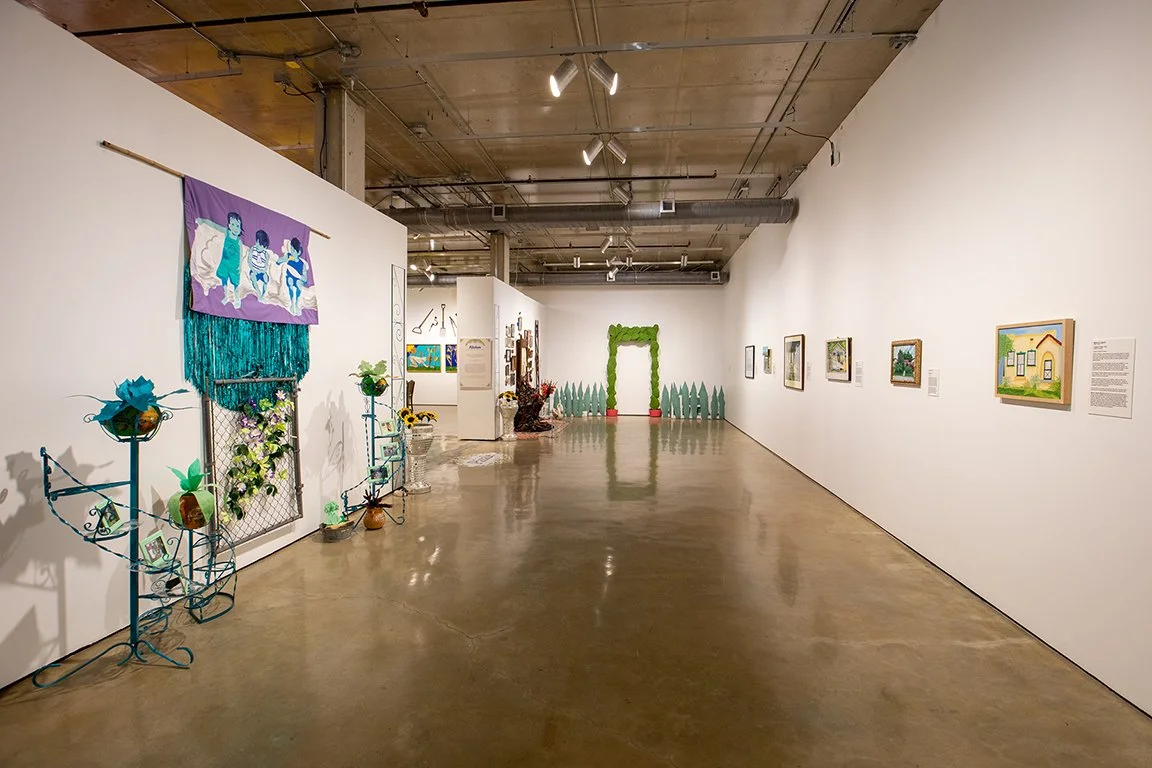
An installation view of “Madre_Land: South Texas Memory & the Art of Making Home” at Centro de Artes, 2025. Image courtesy of the City of San Antonio
In Spanish, the phrase “mi casa es su casa” (“my house is your house”) is a warm welcome for guests into one’s home. Bonnie Ilza Cisneros, curator of Madre_Land: South Texas Memory & the Art of Making Home at Centro de Artes in San Antonio, uses this phrase as the foundation for the exhibition. Madre_Land centers rooms of various Mexican American homes as the sites of intergenerational exploration by 27 South Texas artists. Throughout the show, the artists depict themes of family, biculturalism, food, heirlooms, local businesses, spirituality, religion, and/or remembrance.
Mexican American scholar Dr. Tomás Ybarra-Frausto created a new essay for this pamphlet, which was published as a zine that is available to all visitors at the gallery’s entrance. The zine’s title is also Ybarra-Frausto’s slogan for the exhibition, which is La Casa de Todos (“the house of everyone”). Ultimately, La Casa de Todos underscores the show’s central premise: that this space, like its stories, belongs to everyone.
Madre_Land is split into several sections across Centro de Artes’ first floor. Each section represents a different area of a Mexican American household, beginning with the front yard, then transitioning to the home’s kitchen, living room, bedroom, and garage spaces. In this review, I consider a selection of artworks that reflect how the home functions as a space of memory, care, and continuity.
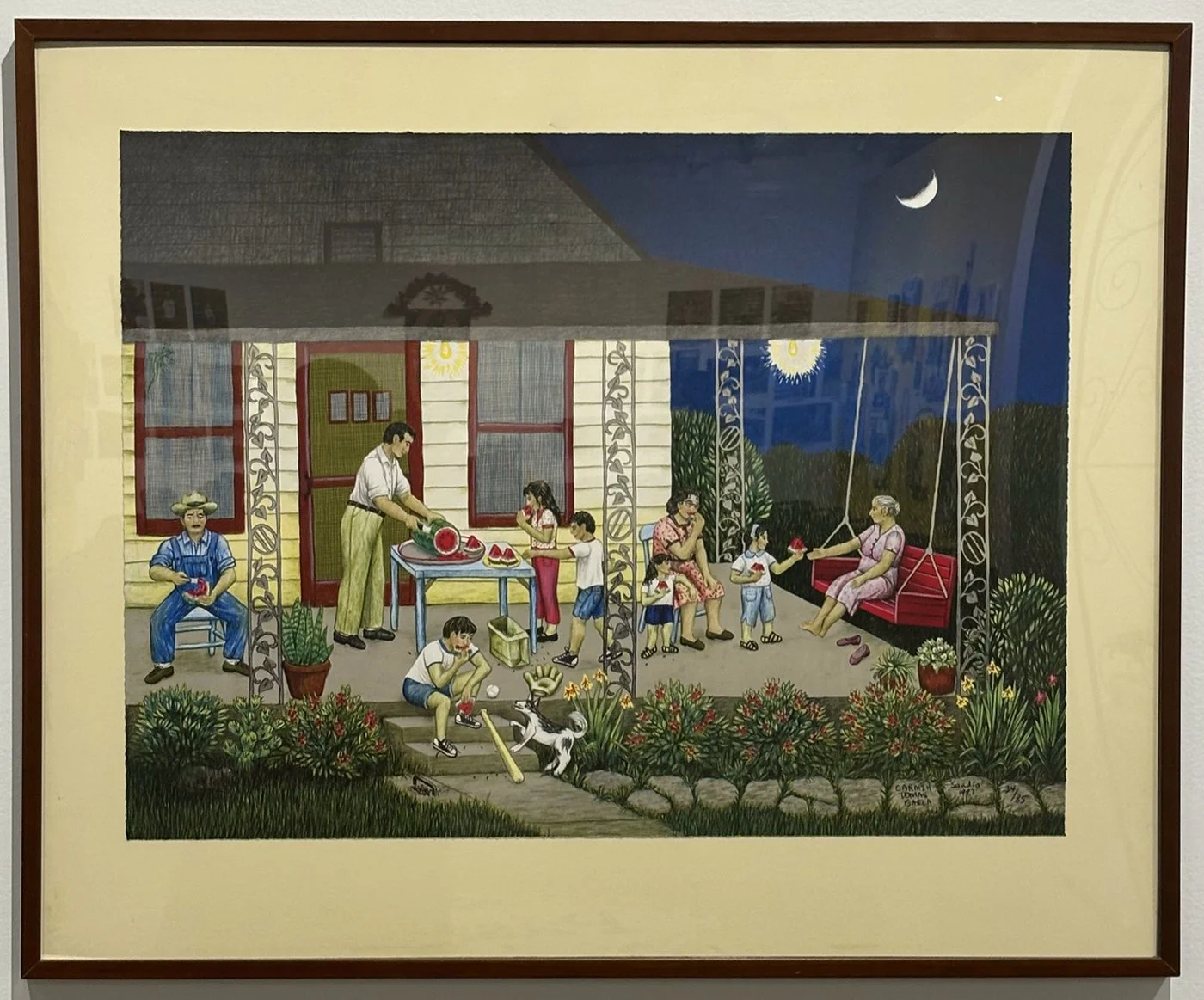
Carmen Lomas Garza, “Sandia (Watermelon),” 1986, lithograph, 36 x 25 1/2 inches. Collection of the City of San Antonio. Image courtesy of the City of San Antonio
Carmen Lomas Garza’s Sandia (Watermelon) shows the artist’s family spending time together on the front porch of her childhood home. Her grandfather cuts the watermelon as her grandmother rests in a hanging hammock, reaching for a slice. The children eagerly gather around, and even the family dog seems drawn to the shared moment. Lomas Garza grew up in Kingsville, where the humid South Texas air stretches across long summer days. She recalls that her grandparents were migrant workers, and that watermelon was among the fruits they harvested. This family portrait captures an intimate, everyday experience shaped by memory, labor, and togetherness.
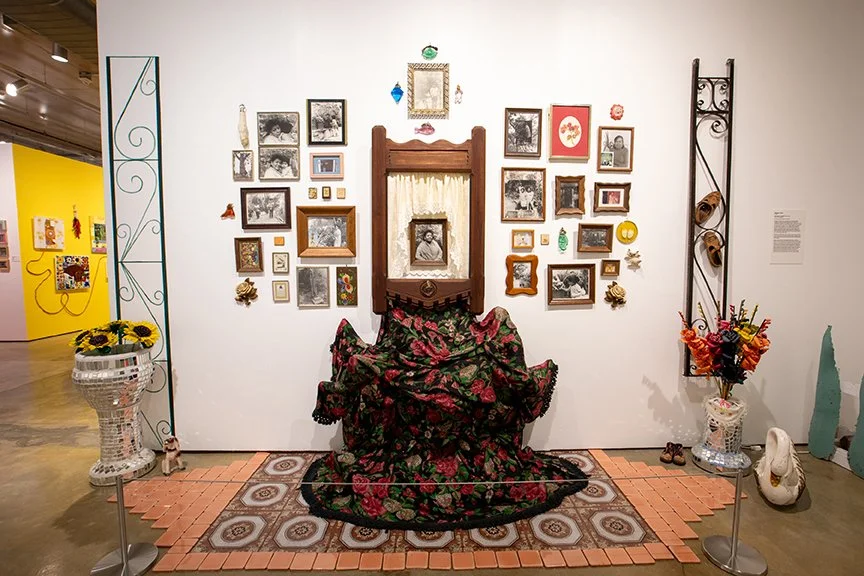
Monica A. Sosa, “Mi Jardín, un archive vivo,” 2025, mixed media installation, dimensions variable. Image courtesy of the City of San Antonio
Next, in her first exhibited installation, Monica A. Sosa takes viewers to Brownsville — where her family has resided for over a century — through a living family archive, maintained by the Sosa-Hernandez family. The installation brings together numerous framed family photographs taken by Sosa. The artist herself does not appear in any of the photos, instead opting to capture the likeness of her mother, daughter, aunts, and sisters. For example, pictured in the center of the installation is Sosa’s mother, Ramona Antonia Sosa, smiling directly at the camera, her photograph surrounded by white fabric that lends the image a reverent, almost memorial quality. Right above her is Sosa’s daughter, Remedios.
Encircling the photographs are objects from the Sosa-Hernandez household, including two- and three-dimensional flowers, encased butterflies, a hand, a diamond, a fish, shoes, a sculptural swan, and sunflowers set in a shiny pot. The objects are curated from Sosa’s family home in Brownsville. Together, these elements form an intergenerational garden, held together by the women in Sosa’s family.
Sosa’s aunt, Petra “Pollin” Hernandez (now deceased) was the caretaker of the family garden. That history imbues the installation with a sense of longing, as the garden becomes not only a site of growth, but also one of remembrance. In a one-on-one conversation with Sosa, she asserts that this work, like much of her work, is centered on “those connections that we have to places and people that never leave.” The Sosa-Hernandez family continues to maintain their gardens, sustaining a legacy of care that bridges past and present.
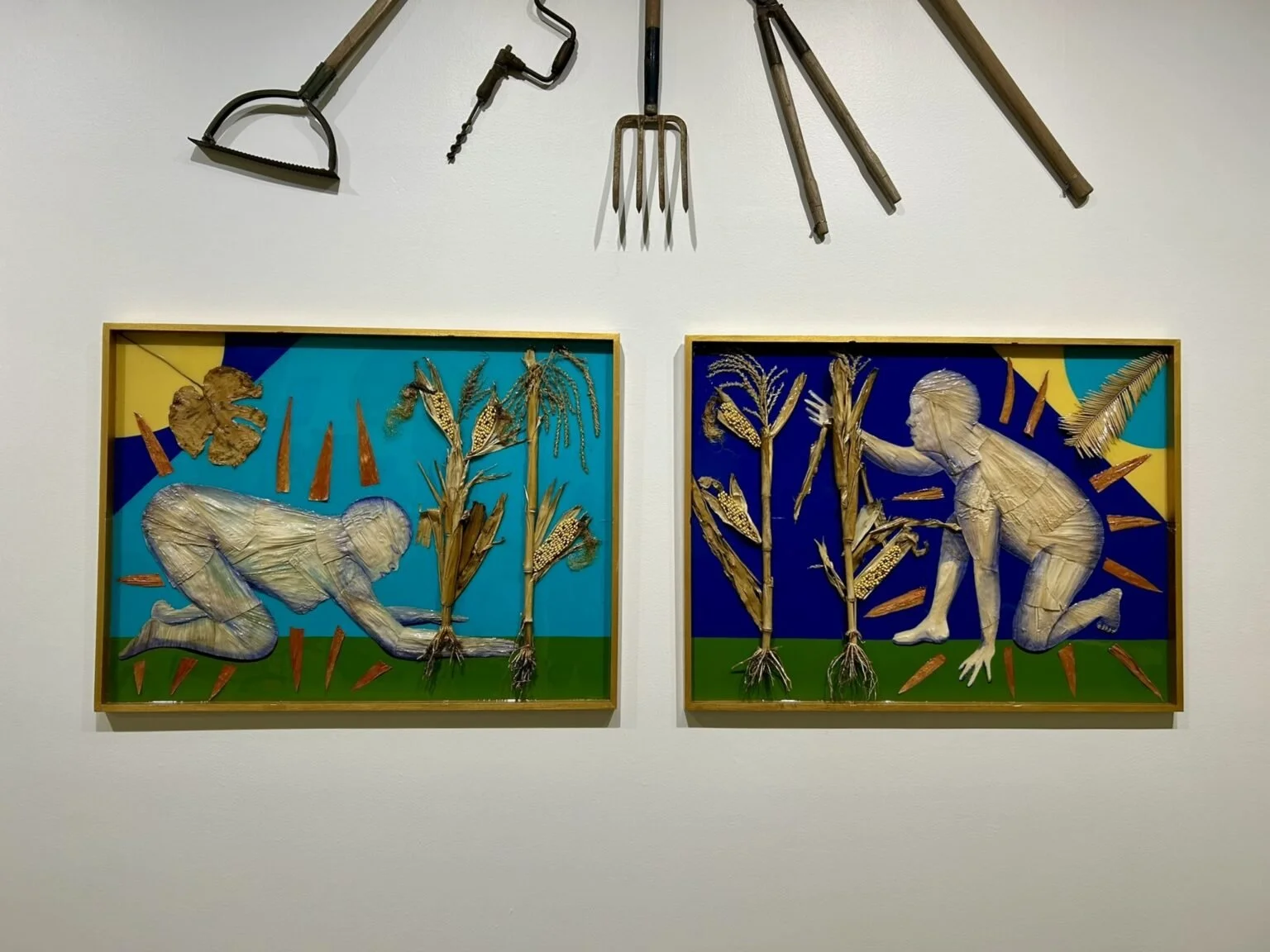
Suzy González, “Sacred Ancestral Maíz” (diptych), 2025, corn stalks, silks, and tassels from artist’s garden, acrylic, corn husks, deer corn, Monsteral, Sago Palm, and resin on panels, farming tools inherited by artist’s grandfather, Doroteo González, diptych panels 36 x 48 inches each, dimensions variable. Image courtesy of the artist
When you enter the kitchen space of the exhibition, you might be stunned by Suzy González’s Sacred Ancestral Maíz. Above the diptych hangs farming tools, further imbuing the work with a sense of ongoing intergenerational responsibility and care, a thread that runs throughout the show. The diptych stands out for its primary material: literal corn husks arranged to form the silhouettes of two figures. Corn husks carry texture, smell, and fragility, grounding the work in the physical realities of cultivation and care. The corn figures tend to the crop itself, embodying the phrase “people of the corn.”
The lines of the corn husks echo both human skin and the linear rows of cornfields that must be carefully maintained to ensure a successful harvest. González references the Popol Vuh, the K’iche’ Maya creation story in which humanity is formed from corn, situating the work within a Mesoamerican worldview where sustenance and being are inseparable. The everyday sacredness of corn is still felt today, as it remains a vital crop not only in Mesoamerica, but across the world for its use in animal feed. This crop, believed to give life to humanity, continues to maintain life on a global scale.
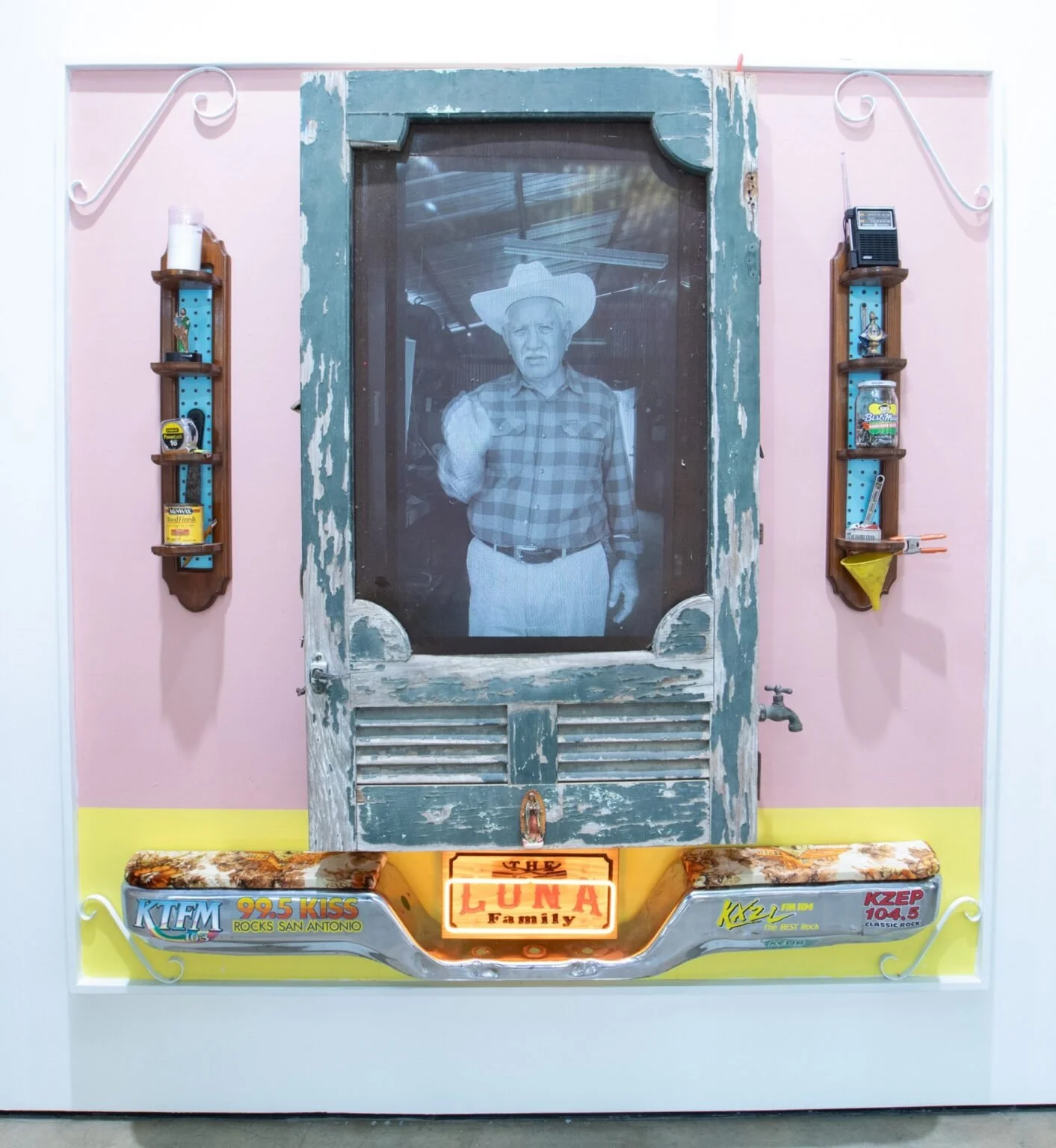
Ruben Luna, “El Garaje,” 2025, mixed media, 6 x 6 feet. Image courtesy of the City of San Antonio
The final artwork in my review takes viewers to another part of the household: the garage. In El Garaje, Ruben Luna grounds his work in the theory of rasquachismo as outlined by Tomás Ybarra-Frausto. To be rasquache is to occupy an “underdog,” working-class position, and it is also a quality embodied in objects and spaces shaped by necessity, reuse, and ingenuity.
Luna and Ybarra-Frausto are both from San Antonio, and it comes as no surprise that the rasquache worldview Ybarra-Frausto describes is readily visible in El Garaje. A Best Maid pickle jar repurposed to hold screws, a neon Luna family sign, and a funnel secured to a garage shelf with pressure pliers all exemplify this sensibility. These materials, while seemingly simple, come together to form a working-class family garage defined by function, repair, and the ongoing labor of making do with what’s at hand.
Madre_Land surprised me in its quiet insistence to slow down. As I moved through the familiar spaces of a home, I became more aware of the labor, memory, and care that sustains those spaces. From front porches and kitchens to gardens and garages, the artworks in this exhibition reveal how Mexican American households function as living archives, shaped by intergenerational knowledge, spirituality, and everyday acts of maintenance. Madre_Land affirms the home not only as a place of belonging, but as a deeply personal and cultural embodiment of identity that is carried from one generation to the next.
Madre_Land: South Texas Memory & the Art of Making Home, curated by Bonnie Ilza Cisneros, is on view through February 22, 2026, at Centro de Artes in San Antonio.