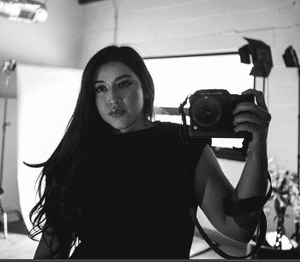
It has been a year since Madre_Land opened at Centro de Artes Gallery in San Antonio, and I am still inside this piece. Some work leaves the studio and stays finished. Altar de la Recámara: Mujer, Ollin, Memory has not let me go that easily, and I have stopped expecting it to. This note is a way of returning to it before the longer essay is ready, and of sharing where the piece came from with the people who have followed it from the beginning.
The recámara
The recámara was my favorite room in my grandmother's home. I knew that once I crossed the threshold and turned the corner, I would find her standing in front of her vanity, with the ceiling fan humming above her and the smell of a freshly struck match hanging in the air. That room was ordinary to me as a child, and it only became something else much later, when I had the honor of being with her as she crossed into the next life.
On her deathbed, I watched her through the vanity mirror, and I began to think of the mirror as another presence in the room. It had seen every stage of her life. It had watched her grow, grieve, love, and change her skin more than once. In return, she had given it her cositas: small objects, trinkets, photographs, and materials scattered across the tabletop and tucked around the glass. I have come to call this arrangement the anatomy of the vanity table. As children, we were allowed to look but never to touch, because these were her treasures and the proof of a life fully lived.
From colonial object to altar
The vanity is not a neutral piece of furniture. It carries a long history tied to gender, consumption, and colonial order, and it is often reduced to a place of self-scrutiny and purchased beauty, where a woman is taught to watch herself the way the world watches her. I wanted to hold that history honestly while also making room for what the vanity became in my grandmother's house, and in so many Xicana homes, where it quietly turned into an altar. It was a place of devotion that looked like everyday life, where the sacred and the mundane shared the same tabletop.
In the installation, the vanity becomes something older than either of those roles. I think of it the way I think of an old mountain or a weathered tree, as a being that holds memory across generations and asks the people in front of it to slow down. In a world that treats our time as something to be taken from us, sitting at the vanity becomes a small refusal, a few minutes that belong to no one else.
Tonalli and the ritual of adornment
While researching this piece, I returned again and again to the Nahua understanding that grooming the hair and nails was a way of tending to one's tonalli, the vital force of the soul. That idea reframed adornment for me entirely. Painting your nails or braiding your hair is not decoration in this sense, but spiritual preparation, a way of gathering yourself before stepping out into a world that would prefer we all look and think the same. To sit before the mirror is to accept being seen, and it is also to claim the right to be seen on your own terms.
Ollin, the Nahuatl word for movement, gave the piece its center. It speaks to the cycle of life and death, the passage between worlds, and a femme energy that moves through generations and is not bound by gender. The vanity holds all of that motion in one place.
The mirror as portal
When my grandmother crossed over, I imagined she had stepped through to the other side of the mirror glass. In my work I call that place the Obsidian Room. It exists in the deepest dark, yet like obsidian itself, it reflects back the brightest light that catches the eye. The installation asks you to stand in two places at once: to look into the mirror as yourself, and to imagine being watched from the other side by everyone who sat there before you.
The vanity watches
The essay that accompanies this piece includes a passage written from the vanity's point of view, following one woman's life from the first time she sees herself in the glass to the moment she steps through it. Here is a portion of it.
The vanity watches
Watches you catch your reflection for the first time as you watch your mother in ritual
Watches you open the red nail polish, staining the table.
Watches you and your primas getting ready to go out.
Watches you tend your first broken heart.
Watches your belly swell, your breasts fill with milk.
Watches you braid your daughter's hair.
Watches you sleep in her empty bed, because it still smells like her.
Watches you paint your nails bright red, noticing how bony your fingers have become.
Watches you leave home again, this time to tend to your mother as she crosses into the next realm.
Watches you stare at yourself in disbelief, seeing your mother's face staring back.
It watches your granddaughter place flowers on the vanity, so you can open your eyes between dreams and see beauty.And finally,
it watches you open your eyes one last time,
look at all your creations,
take a final breath,
look at yourself one final time
and step across the threshold, into the other side of the mirror.
The "you" in this passage is one woman, but she keeps becoming the women around her. She watches her mother in ritual as a girl and, years later, finds her mother's face staring back at her from the glass. She stains the table with red polish as a child and paints her bony fingers the same red as an old woman. The girl who once watched her mother at the vanity grows into the daughter who leaves home to sit with that same mother as she crosses into the next realm. That folding of generations into one body is Ollin, the movement between worlds that gives this piece its name, and the vanity is the one presence that sees all of it. The granddaughter placing flowers on the table so her grandmother can see beauty between dreams is me, in that recámara, in the last days I had with her.
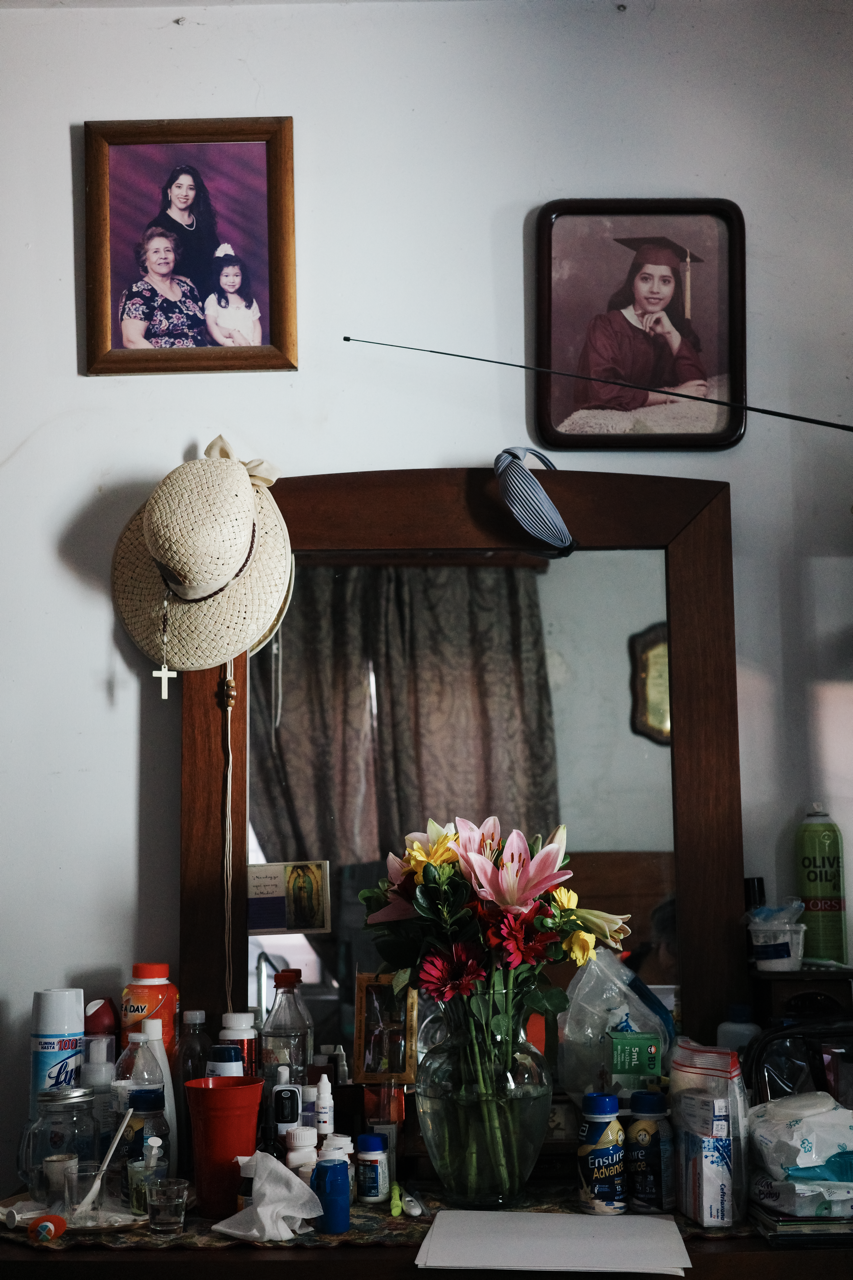
Near the end of her life, my grandmother told me, "No dejes de buscarme." I still answer her the same way. María de la Paz, (presente!). Siempre te seguiré buscando, until we meet again in the Obsidian Room.
The full essay, tracing the vanity from colonial object to altar to grandmother through Nahua numerology, spatial theory, and lived experience, arrives in early 2027. Newsletter subscribers will read it first.