The Vanity Altar Candle: Tezcatlipoca, Ollin, and the Modern Xicanx Vanity
The Vanity Altar Candle
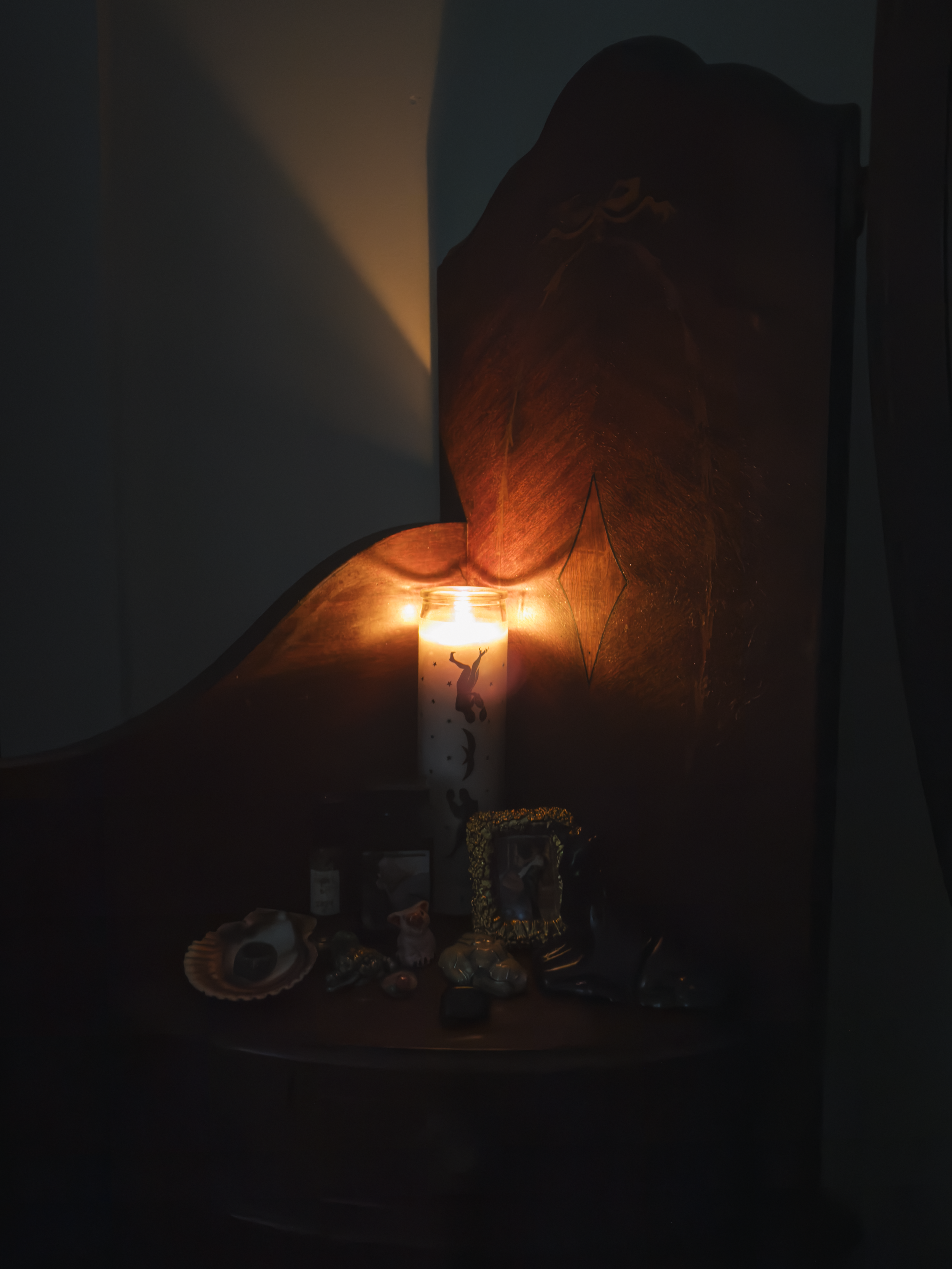
On the modern Xicanx vanity table, there are a few objects that always find their place: the perfume, the photographs, a totem or two, and a candle burning low between them, turning an ordinary morning into an altar. I have been writing about the anatomy of the vanity table for a while now, and of everything that lives on it, the candle is the one that asks you to pause and pray. It is the object that makes the vanity an altar.
Where it began
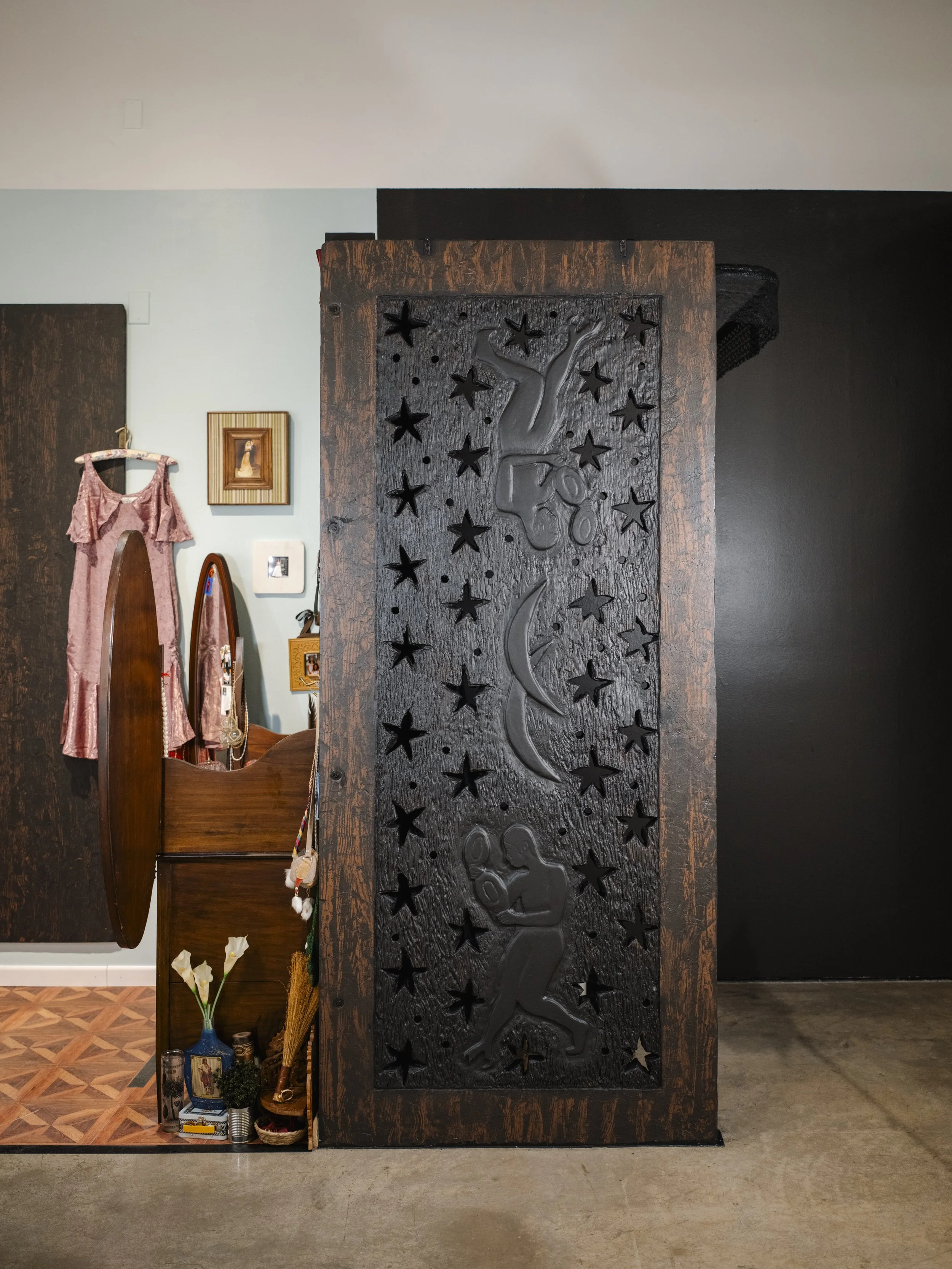
This candle comes from Altar de la Recámara: Mujer, Ollin, Memoria, the installation I built from memories of my grandmother’s vanity for Madre_Land: South Texas Memory and the Art of Making Home at Centro de Artes in San Antonio. Within it is a hand-carved panel set in front of a one-way mirror, so the piece can never be fully seen by one person alone. Two people have to stand on either side and trade places to understand it, the way a confessional only works when someone is on both sides of the screen. The design on this candle is a faithful reproduction of that panel.
The figures: a femme Tezcatlipoca
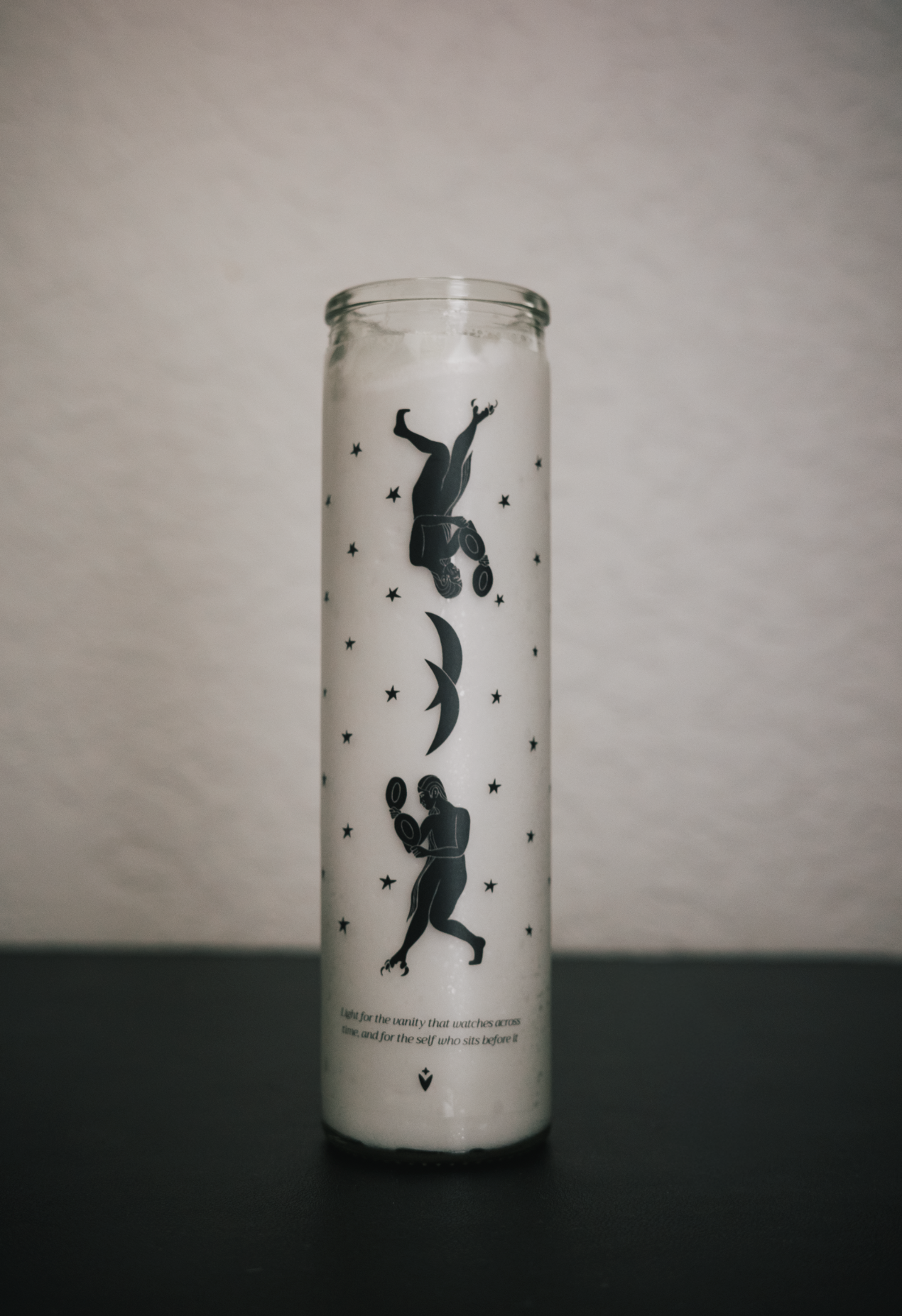
The two figures are a femme Tezcatlipoca in two stages of life, youth and elder, facing each other across time. Tezcatlipoca is a Nahua teotl whose name means “Smoking Mirror,” and in his obsidian mirror he sees everything. It is a mirror that does not flatter. It shows you the truth about yourself, which is exactly what a vanity asks of us each morning. Tezcatlipoca is traditionally depicted as male, and I carved him in a femme’s form so that the women who sit at these vanities could see themselves in that mirror.
The stars and the jaguar
Tezcatlipoca rules the night sky, and his animal disguise is the jaguar, whose spotted coat was likened to a sky full of stars. That is why the figures move through a field of stars, carried through the night.
The eagle talons and ollin
The figures stand on eagle talons. In Nahua teachings, the eagle is the sun: the rising sun is the ascending eagle and the setting sun is the descending eagle. On the candle, one figure rises as the other descends, morning and evening, youth and elder. That turning is ollin, movement, the word at the center of the installation’s title, and the same movement the Nahua cosmology names in Nahui Ollin, the sun of our present age. Held together, the design carries a full cycle, night through the jaguar and day through the eagle, with a woman’s life turning between them.
Two moons
Between the figures hang two crescent moons. One is the moon as it was on the night I was born, and the other is the moon as it was on the night my grandmother was born. I find it peculiar and serendipitous that we were born under the same moon, though two generations apart. It is my toquecito.
Bringing the panel home
This candle exists so that a piece of the installation can leave the gallery and return to where it started, on a vanity, a dresser, or a bedside altar. It is not necessarily a candle you pray to, although you could, if you wanted to pray to your future self, which I often do. Mainly, it keeps you company while you look at yourself honestly, the way our grandmothers’ veladoras kept them company beside their saints and their photographs. Light it for the vanity that keeps watch across time, and for the self who sits before it.
Where to find it
The vanity altar candle will be on my table this fall:
Día de los Muertos at Crown Hill Cemetery, Sunday, October 25, 12 to 5 PM, 700 W. 38th St., Myaamionki (Indianapolis)
Open studio hours at Suite 206, CAMi, November 6 and 7
CAMi Art Market, Sunday, November 8
To hear about new work and future studio releases first, subscribe to the studio newsletter.